
This browser-based title strips away reels, paylines and bonus features, focusing instead on timing and risk management. Four difficulty settings adjust lane counts and traffic density, letting you choose volatility on every round. We tested Chicken Road 2 across all modes, examined its multiplier structure and assessed whether it offers enough depth to hold your attention beyond a few trial runs.
Chicken Road 2: key facts
| Provider | InOut Games |
|---|---|
| Type | Browser-based crash mini-game |
| RTP | Not disclosed by provider |
| Volatility | Player-selectable (Easy, Medium, Hard, Hardcore) |
| Min / max bet | £0.50 minimum (partner casinos set upper limits) |
| Max win | Varies by difficulty tier and number of lanes crossed |
| Mobile | Yes, browser-based (no app required) |
| Demo | Yes |
A polished traffic-dodging mini-game that delivers clear multiplier progression and adjustable volatility, though limited variety may test long-term appeal.
What Is Chicken Road 2?
Chicken Road 2 belongs to the crash-game family, a category in which players watch a multiplier climb and decide when to collect before a random event ends the round. Instead of a graph or rocket, InOut uses a chicken crossing lanes of traffic. Each successful lane applies a fixed multiplier to your wager, compounding as you advance. A turquoise car moves across the screen at unpredictable intervals; if it strikes your chicken, the round ends and your stake is lost.
The game offers four difficulty tiers—Easy, Medium, Hard and Hardcore—each altering the total number of lanes and traffic flow. Easy mode presents 30 lanes with sparser vehicles, giving you more room to accumulate multipliers at a gentler pace. Hardcore restricts you to 18 lanes with dense traffic, demanding precise timing under maximum pressure. Unlike traditional slots, volatility is not fixed: you select it before every round, tailoring risk to your session bankroll and mood.
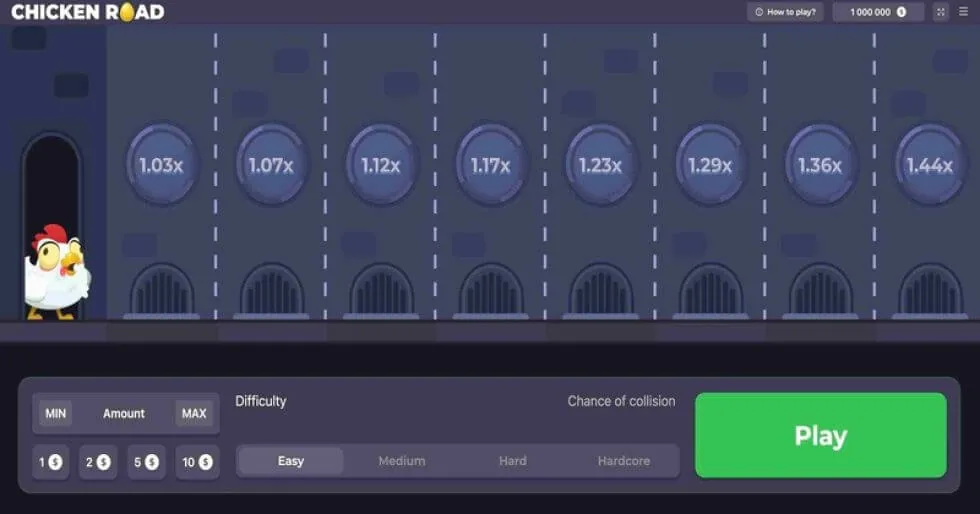
Visually, Chicken Road 2 refines its predecessor with updated scenery and revised traffic patterns. The central avatar is a detailed white chicken with a five-pointed crimson comb, matching wattle, triangular orange beak and yellow legs. A subtle idle animation loops every two seconds, reinforcing the connection between player and character. Circular manhole icons on each lane display your current multiplier, marked with concentric rings and spoke patterns. The interface is clean, functional and devoid of clutter, ensuring you can follow your progress at a glance.
A live-wins feed runs along the top, streaming recent payouts from other participants. An online counter reports active users, and the latest winner's username, profile image and prize amount appear in the start zone. These social elements confirm genuine activity and add a sense of shared play, though they remain unobtrusive enough not to distract from your own decisions.

How to Play Chicken Road 2
1: Select Your Bet and Difficulty
The control strip at the base of the screen displays four circular bet selectors—£0.50, £1, £2 and £7—each with dark grey fills, pale borders and white numerals. Choose your wager according to your session budget. Next, open the difficulty menu and pick from Easy (30 lanes), Medium (25 lanes), Hard (22 lanes) or Hardcore (18 lanes). The game defaults to Medium, a setting that balances traffic density and payout scope for most players. Higher tiers do not increase multiplier values but do raise the collision likelihood with each step.
2: Launch the Round and Cross Lanes
Press the prominent green 'Play' button to place your chicken at the starting position. Click to advance one lane at a time, or enable 'Space to spin and go' in the settings menu to use the keyboard Space key instead. Each successful crossing applies the lane's fixed multiplier—lane one offers 1.01×, lane two raises it further, and so on until lane six delivers the peak single-lane factor of 1.19×. These multipliers compound, so reaching lane six means you have collected the boost from every prior crossing. The circular manhole icon on each lane updates to show your active multiplier as you progress.
3: Cash Out or Continue
At any point before entering the next lane, you may withdraw and lock in your current total. The turquoise car moves across the screen at unpredictable intervals; if it strikes your chicken, the round ends immediately and your stake is forfeited. There is no pattern to memorise, no signal to anticipate—collision timing is governed by the game's random-number generator. Your decision hinges on reading the traffic flow, assessing your accumulated multiplier and judging whether the potential gain from the next lane justifies the added risk. Once you cash out, your winnings are credited to your balance and displayed with a green plus symbol.
How Much Can You Win on Chicken Road 2?
Chicken Road 2 does not publish a fixed maximum win in the traditional sense. Your payout depends on three variables: initial wager, difficulty tier and the number of lanes you cross before cashing out or colliding. Each lane applies a set multiplier—starting at 1.01× for lane one and peaking at 1.19× for lane six—and these factors compound as you advance. Reaching lane six on a £1 bet, for instance, delivers a total multiplier higher than 1.19× because you have collected the incremental boosts from lanes one through five.
In practice, the maximum theoretical win occurs when you successfully cross every lane in Easy mode—30 lanes in total—on the highest stake accepted by your chosen casino. Partner operators set their own upper bet limits, so consult the game's bet panel at your casino to confirm the ceiling. Even on Easy, completing all 30 lanes is exceptionally rare: traffic density increases subtly with each crossing, and the turquoise car's random appearances grow harder to avoid. Most sessions will see you cashing out between lanes eight and fifteen, balancing accumulated multiplier against rising collision risk.
Key payout principles:
- Multipliers are fixed per lane and compound as you progress, not randomised like slot symbols.
- Higher difficulty tiers reduce total lane count but do not increase individual lane multipliers; they simply raise collision frequency.
- Cashing out early secures smaller, more frequent wins; pushing deeper yields larger multipliers but greater risk of total loss.
- The game does not cap your potential payout beyond your casino's stake limit and the number of lanes you successfully navigate.
Strategies and Good Habits for Chicken Road 2
Set a Target Multiplier Before Each Round
Decide in advance at which multiplier you will cash out—whether 2×, 3× or higher—and stick to that threshold. Chasing 'just one more lane' after reaching your target is the quickest route to losing your accumulated stake. A predetermined exit point removes emotion from the decision and keeps your session disciplined. Adjust your target according to difficulty: Easy mode tolerates deeper runs, while Hardcore demands earlier cash-outs due to dense traffic.
Match Difficulty to Your Bankroll
Easy and Medium modes offer longer runs and steadier multiplier accumulation, making them suitable for smaller bankrolls or conservative sessions. Hard and Hardcore tiers compress the lane count, raising collision likelihood and introducing sharper swings. If your balance is limited, favour lower difficulty settings to extend playtime and reduce the frequency of total losses. Conversely, if you are comfortable with higher volatility and have budget to spare, Hardcore rounds deliver larger multipliers in fewer crossings—provided you survive.
Track Traffic Patterns Without Relying on Them
While you may notice brief lulls or bursts in vehicle flow, these patterns are cosmetic. The turquoise car's collision timing is governed by a random-number generator, not a predictable sequence. Observing traffic can help you time your clicks to avoid obvious clusters, but do not mistake visual rhythm for a system. The game remains fundamentally random, and no amount of pattern-spotting will alter the underlying probabilities. Use traffic observation as a situational aid, not a strategy foundation.
Use the Demo to Calibrate Risk Tolerance
Chicken Road 2 offers free-play access without requiring an account or payment method. Spend time in demo mode experimenting with each difficulty tier, testing different cash-out thresholds and observing how quickly multipliers compound. This practice costs nothing and reveals whether you prefer frequent small wins or infrequent large payouts. Once you have a clear sense of your risk appetite and preferred difficulty, transition to real-money play with a strategy already shaped by hands-on experience.
Free Demo or Real Money?
Chicken Road 2 provides a full-featured demo that mirrors the real-money version in every respect: lane counts, multipliers, traffic density and interface layout are identical. The only difference is that demo credits carry no cash value and cannot be withdrawn. This makes the free mode ideal for learning the multiplier structure, testing difficulty tiers and refining your cash-out discipline without financial exposure.
Switch to real-money play when you have a clear strategy and understand how collision frequency scales with difficulty. Partner casinos typically require account registration and age verification before accepting wagers, and responsible gambling tools—deposit limits, session timers, self-exclusion—are available through your account settings. Remember that mini-games like Chicken Road 2 are designed with a house edge; the multipliers you collect are averages across thousands of rounds, and individual sessions will swing above or below that figure. Play within your means, set strict loss limits and treat any winnings as a bonus rather than an expectation. This is entertainment with financial risk, not a income strategy, and it is restricted to those aged 18 and over.
Our Opinion on Chicken Road 2
Chicken Road 2 succeeds as a streamlined crash game that replaces abstract multiplier graphs with a tangible traffic-dodging scenario. The compounding lane-by-lane structure is easy to grasp, and the four difficulty tiers give you genuine control over volatility—something traditional slots rarely offer. The white-chicken avatar is charmingly detailed, the circular multiplier indicators are clear, and the live-wins feed adds a layer of social proof without overwhelming the screen. InOut has refined the interface to the point where every click and cash-out feels purposeful.
However, the simplicity that makes Chicken Road 2 approachable also limits its long-term appeal. Once you have tested all four difficulty modes and settled on a preferred cash-out strategy, the gameplay loop becomes repetitive. There are no bonus rounds, no secondary features and no narrative progression—just lane crossings and multiplier accumulation. Players accustomed to the variety of modern slots may find the lack of additional mechanics monotonous after a few dozen rounds. The game also does not disclose its return-to-player percentage, leaving you to trust InOut's fairness claims without transparent mathematics. While this omission is common among crash-style mini-games, it remains a shortcoming for players who value published RTP figures.
Chicken Road 2 is best suited to short, focused sessions where you want clear risk-reward decisions and immediate feedback. It delivers on its core promise—navigate traffic, multiply your stake, cash out when ready—without unnecessary embellishment. If you enjoy crash games or are curious about alternatives to slot reels, this title is worth exploring. Just temper your expectations regarding variety and long-term depth.
👍 Pros
- Four difficulty tiers let you adjust volatility on every round, matching risk to your bankroll and mood.
- Compounding multipliers are transparent and easy to follow via circular lane indicators.
- Full-featured demo mode requires no account or payment details, ideal for risk-free practice.
- Clean, functional interface with live-wins feed and detailed chicken avatar.
👎 Cons
- Repetitive gameplay loop with no bonus features or secondary mechanics to sustain long-term interest.
- Provider does not disclose RTP, leaving fairness assessment to trust rather than published mathematics.
- Limited strategic depth once you have established a preferred difficulty and cash-out threshold.
Frequently asked questions
What is the RTP of Chicken Road 2?
InOut Games does not publish a return-to-player figure for Chicken Road 2. The game uses a random-number generator to determine collision timing, but without disclosed RTP, you cannot verify the long-term payout percentage. This is typical of crash-style mini-games but remains less transparent than traditional slots, which usually display RTP in their paytables.
Can I play Chicken Road 2 on mobile?
Yes. Chicken Road 2 is browser-based and adapts to mobile screens without requiring a dedicated app. Open the game through your casino's mobile site, and the interface will scale to fit your device. Touch controls replace mouse clicks, and the 'Space to spin and go' keyboard shortcut is unavailable on mobile, but all other features—difficulty selection, bet adjustment, live-wins feed—function identically.
Which difficulty mode should I choose?
Start with Medium if you are new to the game; it presents 25 lanes and balanced traffic density, offering a fair introduction to the multiplier structure. Move to Easy (30 lanes) if you prefer longer runs and steadier accumulation, or try Hard (22 lanes) and Hardcore (18 lanes) if you want sharper volatility and are comfortable with frequent total losses. Match difficulty to your session bankroll and risk tolerance, and use demo mode to test each tier before wagering real money.
Is there a maximum win limit?
Chicken Road 2 does not impose a fixed maximum win. Your payout depends on your initial wager, the difficulty tier you selected and the number of lanes you cross before cashing out. The theoretical maximum occurs when you complete every lane in Easy mode (30 lanes) on the highest stake your casino allows. In practice, most sessions yield moderate multipliers because collision risk increases with each crossing, making deep runs rare.
Does Chicken Road 2 have a pattern I can learn?
No. The turquoise car's collision timing is governed by a random-number generator, not a predictable sequence. While you may observe temporary lulls or clusters in traffic flow, these are cosmetic and do not indicate future outcomes. Treat every lane crossing as an independent event with fixed probabilities determined by your chosen difficulty tier. Pattern-spotting or timing systems will not alter your long-term results.