
We spent multiple sessions scaling Tower Rush's floors, testing its bonus mechanics, and evaluating whether the 98.5% RTP holds up under different betting approaches. This review dissects the game's structure, explains the cashout dynamics, and assesses whether the tower-building theme adds substance beyond cosmetic variation on familiar crash gameplay.
Tower Rush: key facts
| Provider | Galaxsys |
|---|---|
| Type | Crash/Building game |
| RTP | 98.5% |
| Volatility | Not specified |
| Min / max bet | £0.01 / £100 |
| Max win | 10,000× |
| Mobile | Yes |
| Demo | Yes |
Tower Rush delivers solid crash mechanics wrapped in vertical progression, though bonus floors feel more decorative than transformative.
What is Tower Rush?
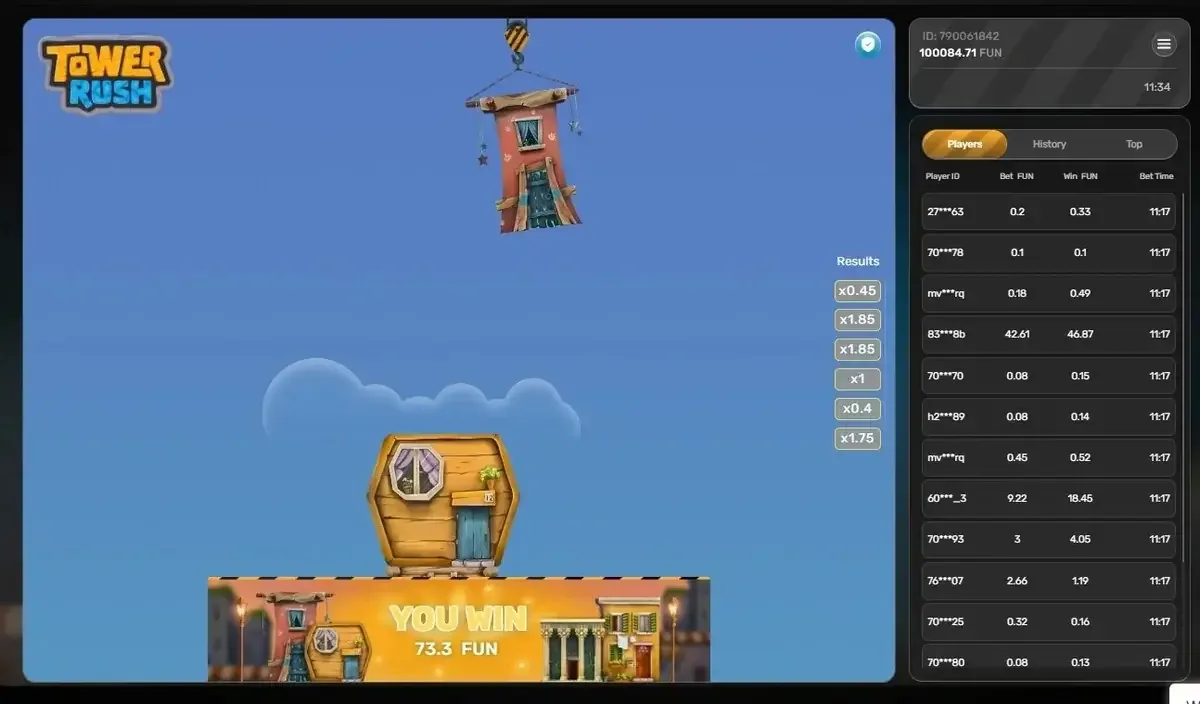
Tower Rush belongs to the crash game family, where timing your exit determines whether you bank a profit or lose everything. Rather than watching a multiplier curve ascend until an unpredictable crash, you place building floors one at a time, with each successful placement increasing your potential winnings. The collapse can strike at any floor, creating the same escalating tension familiar from Aviator, Crash, or Spaceman—but here you're constructing a tower rather than following an aircraft or rocket.
Galaxsys positions the game as a building challenge with 36 discrete floors, each mapped to a specific multiplier. Start your climb at £0.01 or go as high as £100 per round, then decide whether to cash out after floor five, push to floor twenty, or chase the top-tier multipliers that promise four-figure returns on modest stakes. The tower layout displays your current position, accumulated winnings, and the distance remaining to peak payouts, giving you constant visual feedback as risk compounds.
Three bonus floor types—Frozen Floor, Temple Floor, and Triple Build—appear randomly during climbs, temporarily altering the risk-reward equation. Frozen Floor locks your current winnings in place for one level, Temple Floor offers an unspecified advantage (details remain vague in official materials), and Triple Build accelerates progression. These modifiers inject variability into otherwise predictable floor-by-floor multiplication, though they don't fundamentally reshape the core cashout dilemma.
How to play Tower Rush?
1: Set your stake and initiate the climb
Select a bet amount between £0.01 and £100 using the interface controls. The betting panel displays your chosen stake, potential multiplier, and projected winnings based on your current floor. Once you confirm the wager, the tower begins construction and you advance through the first floor automatically. Your initial stake is now at risk, and the multiplier starts ticking upward with each successful floor placement.
2: Place floors and watch the multiplier grow
Each floor you successfully place increases the multiplier according to Tower Rush's fixed payout structure. Early floors deliver modest returns—perhaps 1.1× or 1.2×—while mid-tier floors accelerate into the 5× to 20× range. Upper floors push multipliers into triple digits, with the 36th floor theoretically reaching the 10,000× ceiling. The game displays which floor you're on, the corresponding multiplier, and your current accumulated profit. A collapse can occur at any floor, immediately ending the round and voiding all winnings.
3: Cash out before the tower collapses
The cashout button remains active from the moment you place your first floor. Click it to transfer your accumulated winnings to your balance instantly. Wait too long and the tower collapses, wiping your profit and returning nothing. Auto-cashout settings let you define a target multiplier—say 5× or 50×—so the game exits automatically when you hit that threshold, removing hesitation from the decision. This feature proves essential for disciplined bankroll management, as manual cashing requires quick reflexes and immunity to greed.
How much can you win in Tower Rush?
Tower Rush caps maximum returns at 10,000× your stake, translating to £1,000 from a £0.10 bet or the full £1,000,000 ceiling (10,000 × £100) if you wager the maximum and survive all 36 floors. In practice, reaching floor 36 demands both luck and nerve, as collapse probability intensifies dramatically in the upper tiers. Most players cash out well before the peak, banking multipliers between 2× and 50× depending on risk appetite and session outcomes.
The 98.5% RTP figure represents long-term statistical return across thousands of rounds, not a guarantee for individual climbs. This percentage sits above the industry average for crash games, which typically hover between 96% and 98%. Over extended play, you'll theoretically lose £1.50 for every £100 wagered, though short-term variance can produce wild swings in either direction. Volatility isn't explicitly rated by Galaxsys, but the game's structure—where one bad floor wipes accumulated gains—suggests high variance regardless of RTP.
- Minimum bet of £0.01 makes Tower Rush accessible for small-stakes exploration and strategy testing without significant bankroll exposure.
- Maximum bet of £100 accommodates high rollers chasing substantial single-round profits, though the collapse risk remains identical regardless of stake size.
- Bonus floors like Frozen Floor and Triple Build can amplify returns beyond standard multipliers, though their random appearance prevents reliable incorporation into pre-planned strategies.
- Early cashouts at 2× to 5× multipliers occur frequently and form the backbone of conservative play, while pushes beyond 20× grow exponentially rarer as collapse probability mounts.

Strategies and practical habits
Set fixed cashout targets before you start
Use the auto-cashout feature to define your exit multiplier in advance—3×, 10×, or whatever threshold aligns with your bankroll goals. This removes emotional decision-making from the equation, as the game executes your plan without hesitation when the target floor arrives. Test different thresholds across multiple rounds to identify which multipliers deliver consistent profits versus which push too far into collapse territory. Discipline beats improvisation in crash games, and pre-set exits enforce that discipline automatically.
Track bonus floor frequency and adjust accordingly
Monitor when Frozen Floor, Temple Floor, and Triple Build modifiers appear during your sessions. If bonus floors cluster in early stages, they offer safer opportunities to push slightly higher than usual since frozen winnings protect against immediate loss. If they remain absent over many rounds, revert to conservative cashout points rather than gambling on bonuses that may never materialise. The game's live statistics panel shows recent outcomes; use it to gauge whether current conditions favour aggressive or cautious climbing.
Vary bet sizes based on bankroll and session performance
After a successful cashout at a high multiplier, consider reducing your next stake to protect profits rather than immediately reinvesting the full windfall. Conversely, if you've endured several early collapses, dropping to minimum bets preserves capital while you regain confidence. Flat betting—wagering the same amount every round regardless of outcomes—works for players who prefer mathematical consistency, but flexible stake sizing adapts to the emotional realities of crash gameplay where tilt and overconfidence derail even sound strategies.
Free demo or real money?
Tower Rush offers a demo mode that mirrors real-money mechanics without financial risk, making it the logical starting point for new players. The demo uses virtual currency to simulate full gameplay, including bonus floors, auto-cashout features, and the complete 36-floor structure. You can test aggressive high-floor pushes, experiment with different cashout thresholds, and observe collapse patterns without bleeding actual funds. This practice environment reveals whether the game's rhythm suits your temperament before you commit a bankroll.
Switching to real money intensifies the psychological pressure considerably. That same floor-15 cashout decision that felt trivial in demo mode becomes agonising when £50 of actual profit hangs in the balance and one more floor could double it—or erase it entirely. The mechanics don't change, but your emotional response to risk absolutely does. Start with minimum stakes when transitioning from demo to real money, treating early paid rounds as an extension of practice rather than immediate profit attempts. Only increase bet sizes once you've internalised the game's tempo and proven your cashout discipline holds under financial stakes. Remember that Tower Rush, like all crash games, is designed for the house edge to prevail over time; the 98.5% RTP means long-term losses are mathematically baked in, regardless of how skilled your timing feels in any given session.
Our verdict on Tower Rush
Tower Rush executes the crash game formula competently, wrapping familiar mechanics in a vertical building theme that provides clearer visual progress than abstract multiplier curves. The 98.5% RTP outpaces many competitors in the genre, and the £0.01 minimum bet makes it accessible for cautious experimentation. Galaxsys has built a stable, responsive game that functions smoothly on mobile and desktop, with auto-cashout features that support disciplined play rather than encouraging reckless pushes.
Yet the tower-building concept feels more cosmetic than transformative. Strip away the floor-placement graphics and you're left with standard crash gameplay where timing your exit determines profit or loss. Bonus floors add occasional variety, but their random appearance and unclear impact (particularly Temple Floor, which remains poorly explained) prevent them from elevating the experience into something genuinely distinct. The 36-floor structure provides psychological waypoints that abstract multiplier curves lack, which helps some players make more considered cashout decisions—but whether that structural clarity justifies Tower Rush over established alternatives depends on personal preference rather than objective superiority. If you find vertical progression more intuitive than watching a curve ascend, Tower Rush delivers a solid iteration. If you're indifferent to theming and simply want optimal RTP and smooth execution, you'll find those qualities here without the game revolutionising the crash format. Players must remember that no strategy overcomes the house edge long-term, and responsible gambling limits remain essential regardless of how engaging the tower climb feels in the moment.
👍 Pros
- 98.5% RTP sits above industry average for crash-style games, offering marginally better long-term value
- £0.01 minimum bet enables low-risk exploration and strategy testing without significant bankroll exposure
- Auto-cashout features support disciplined play by executing pre-defined exit strategies without emotional interference
- 36-floor structure provides clear visual progress and psychological waypoints absent in abstract multiplier curves
👎 Cons
- Bonus floors appear randomly with unclear frequency and impact, preventing reliable strategic incorporation
- Tower-building theme feels cosmetic rather than mechanically transformative compared to standard crash games
- Maximum 10,000× payout requires surviving all 36 floors, an outcome that collapses far more often than it completes
Frequently asked questions
What does the 98.5% RTP mean for Tower Rush?
The 98.5% return-to-player percentage represents the theoretical long-term statistical average: across thousands of rounds, the game returns £98.50 for every £100 wagered, with the remaining £1.50 forming the house edge. Individual sessions will deviate wildly from this figure due to variance, and no strategy can eliminate the mathematical advantage favouring the house over extended play.
How do bonus floors work in Tower Rush?
Frozen Floor, Temple Floor, and Triple Build appear randomly during climbs. Frozen Floor locks your current winnings for one level, protecting against immediate loss. Triple Build accelerates progression through multiple floors at once. Temple Floor's exact mechanics remain vaguely documented by Galaxsys, though it purportedly offers some advantage during that level. Their random nature prevents consistent strategic planning around these modifiers.
Can I actually reach the 10,000× maximum win?
Reaching the 36th floor and claiming the full 10,000× payout is theoretically possible but extraordinarily rare in practice. Collapse probability increases as you climb, making survival through all floors a low-frequency outcome. Most players cash out between 2× and 50×, banking modest profits rather than risking accumulated gains for the peak multiplier. The maximum exists as a ceiling rather than a realistic target for typical sessions.
Is Tower Rush provably fair?
Galaxsys states Tower Rush uses provably fair algorithms where the collapse point is determined before each round begins, with cryptographic verification theoretically available. However, 'provably fair' doesn't guarantee wins or eliminate the house edge—it simply means outcomes aren't manipulated after the round starts. The 98.5% RTP still applies, and players lose money over time regardless of fairness verification.
Should I use auto-cashout or manual cashing?
Auto-cashout enforces pre-defined exit strategies without emotional interference, making it superior for disciplined bankroll management. Set a target multiplier that aligns with your risk tolerance, and the game executes it automatically when reached. Manual cashing offers flexibility to react to bonus floors or gut feelings, but opens the door to greed-driven mistakes where you delay one floor too long and lose everything. For most players, auto-cashout produces more consistent results over time.